Skip to content

Introduction to Robot Operating Systems and Machine Learning (Course 2 of 4)
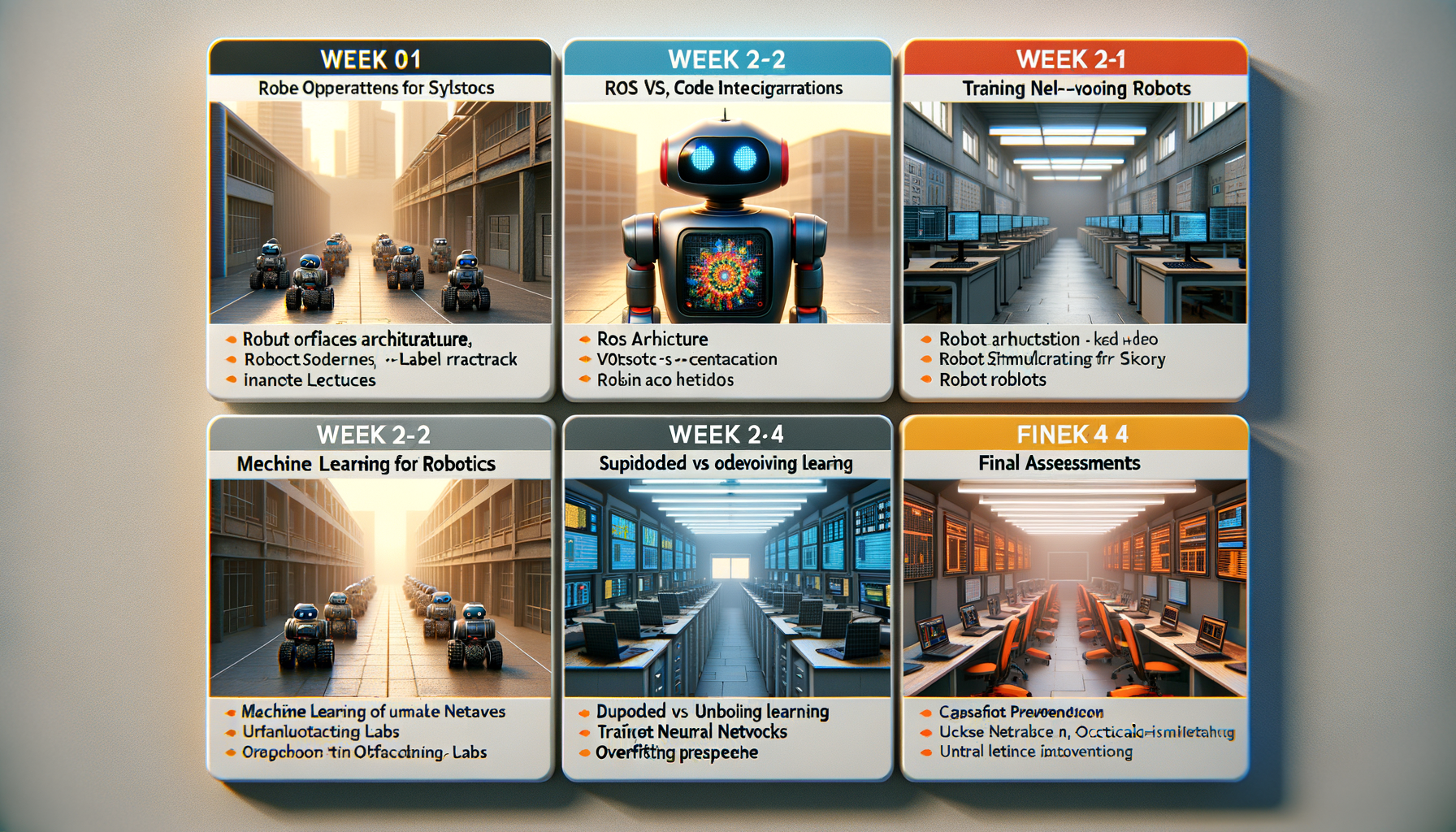
This course provides an in-depth exploration of Robot Operating Systems (ROS) and their applications in robotics. In Week 1, learners ...
Show more
Instructor
Jason James
- Description
- Curriculum
- FAQ
- Grade
Week 1: Robot Operating Systems (ROS) Basics
Written Lectures
- ROS architecture: nodes, topics, and services
- Integrating VS Code with ROS for robotics development
- Remote robotics labs using ROS
Labs (VS Code + PlatformIO + ROS)
- Set up a simple ROS workspace in VS Code
- Write and run a ROS node to control a virtual robot
- Use ROS tools to visualize sensor data and robot state
Audio Lectures
- "ROS in Research and Industry"
- "Ethics in Robotics"
Assessments
- Matching Quiz: ROS components and functions (10 questions)
- MCQ Quiz: 40 questions on ROS and remote labs
Week 2: Obstacle Avoiding Robots
- Build and program an obstacle-avoiding robot using Arduino, sensors, and motors
- Document the design, code, and testing process
- Present a video demo and a written report
Assessments
- 40-Question MCQ: Comprehensive final covering all course topics
- Capstone Grading Rubric: Functionality (40%), documentation (30%), innovation (30%)
Week 3: Machine Learning for Robotics
Written Lectures
- Supervised vs. unsupervised learning in robotics (e.g., object recognition, path prediction)
- Training neural networks for sensor data (LiDAR, cameras) using TensorFlow/PyTorch
- Overfitting prevention: Cross-validation and regularization techniques
Labs (VS Code + PlatformIO)
- Train a CNN in Python to classify objects from a simulated camera feed
- Deploy the model on an ESP32 using PlatformIO’s ML model quantization tools
Audio Lectures
- "AI in Autonomous Vehicles" (25 mins)
- "Ethical AI in Robotics" (20 mins)
Assessments
- Matching Quiz: ML algorithms vs. robotic applications (10 questions)
- MCQ Quiz: 40 questions on neural networks, data preprocessing, and ethics
Week 4: Robot Operating System (ROS 2) Architecture
Written Lectures
- ROS 2 nodes, topics, and services with DDS middleware
- ROS 2 vs. ROS 1: Key differences and industry adoption
- Simulating robots in Gazebo with ROS 2
Labs (VS Code + PlatformIO)
- Set up a ROS 2 workspace in VS Code
- Program a UR5 robot arm to perform pick-and-place tasks using ROS 2 control
Audio Lectures
- "ROS 2 in Industrial Automation" (30 mins)
- "Case Study: Amazon Warehouse Robots" (25 mins)
Assessments
- Matching Quiz: ROS 2 components vs. functions (10 questions)
- MCQ Quiz: 40 questions on ROS 2 architecture and Gazebo simulations
Week 1: Robot Operating Systems (ROS) Basics
-
1
 ROS architecture: nodes, topics, and servicesIn this lesson, "Understanding ROS Architecture: Nodes, Topics, and Services Explained," students will delve into the core components of the Robot Operating System (ROS) architecture. They will learn how nodes interact through topics and services, gaining practical insights into building efficient robotic applications. By the end of the lesson, participants will have a solid grasp of ROS's fundamental concepts, enabling them to design and implement their own robotic systems effectively.
 -
2
Integrating VS Code with ROS for robotics developmentIn this lesson, "Seamless Robotics Development: Integrating VS Code with ROS," students will explore how to enhance their robotics programming by seamlessly integrating Visual Studio Code with the Robot Operating System (ROS). Participants will gain hands-on experience in setting up their development environment, utilizing powerful debugging tools, and streamlining their workflow for efficient robotics project management. By the end of the lesson, students will be equipped with the skills to boost their productivity and creativity in robotics development.
-
3
Remote robotics labs using ROSIn this engaging lesson, "Exploring Remote Robotics Labs with ROS: A Hands-On Guide," students will dive into the world of remote robotics, discovering how to effectively utilize the Robot Operating System (ROS) to control and interact with robotic systems from a distance. They will gain practical experience by setting up and executing tasks in remote robotics labs, enhancing their understanding of real-time communication, sensor integration, and robot programming in a collaborative environment. Prepare to innovate and transform your approach to robotics!
-
4
 Getting Started: Setting Up a Simple ROS Workspace in VS Code
 -
5
 Matching Quiz: ROS components and functions
 -
6
MCQ Quiz: 40 questions on ROS and remote labs
Week 2: Obstacle-Avoiding Robots
-
7
Design and Program an Obstacle-Avoiding Robot with Arduino
-
8
From Concept to Code: Documenting Your Design and Testing Journey
-
9
Show and Tell: Video Demo and Written Report Assignment
-
10
40-Question MCQ: Comprehensive quiz covering all previous robotics course topics
-
11
Capstone Grading Rubric: Functionality, documentation, innovationIn this lesson, students will delve into the Capstone Grading Rubric, focusing on the key criteria of functionality, documentation, and innovation. Through engaging activities and real-world examples, learners will develop the skills to critically evaluate their projects and ensure they meet excellence standards, paving the way for successful capstone presentations.
-
12
 Capstone Project OverviewIn "Capstone Project Essentials: Your Guide to Success," students will gain a comprehensive understanding of the capstone project process, including how to define objectives, conduct research, and present findings effectively. By the end of this lesson, participants will be equipped with practical strategies and tools to successfully navigate their own capstone projects and showcase their skills with confidence.
Week 3: Machine Learning for Robotics
-
13
Supervised vs. unsupervised learning in roboticsIn this engaging lesson, "Decoding Robotics: Supervised vs. Unsupervised Learning," students will explore the fundamental differences between supervised and unsupervised learning techniques in the context of robotics. Through hands-on examples and interactive discussions, learners will gain a clear understanding of how these approaches impact robot training, decision-making, and real-world applications, empowering them to make informed choices in their robotics projects.
-
14
Training neural networks for sensor data using TensorFlow/PyTorchIn this lesson, students will dive into the exciting world of neural networks by mastering the techniques for training them with sensor data using both TensorFlow and PyTorch. Participants will gain hands-on experience in data preprocessing, model design, and performance evaluation, equipping them with the essential skills to harness the power of AI in real-world applications. Join us to unlock the potential of sensor data and elevate your machine learning expertise!
-
15
Overfitting prevention: Cross-validation and regularization techniquesIn this lesson, "Mastering Model Performance: Overfitting Prevention through Cross-Validation and Regularization," students will explore essential techniques to enhance model accuracy and reliability. By mastering cross-validation and regularization methods, learners will gain the skills to effectively prevent overfitting, ensuring their models perform optimally on unseen data. Join us to unlock the secrets behind robust modeling and elevate your data science expertise!
-
16
Building a CNN in Python for Object Classification from Simulated Camera Feeds
-
17
Matching Quiz: ML algorithms vs. robotic applications
-
18
MCQ Quiz: 40 questions on neural networks, data preprocessing, and ethics
Week 4: Robot Operating System (ROS 2) Architecture
-
19
ROS 2 nodes, topics, and services with DDS middlewareIn this engaging lesson, students will delve into the core components of ROS 2, exploring the intricacies of nodes, topics, and services, all powered by DDS middleware. Through hands-on examples and interactive discussions, learners will master how these elements work together to enable seamless communication in robotic systems, equipping them with the skills necessary to design and implement robust ROS 2 applications. Join us and unlock the potential of modern robotics!
-
20
ROS 2 vs. ROS 1: Key differences and industry adoptionIn this lesson, students will explore the fundamental differences between ROS 1 and ROS 2, delving into their architectures, features, and the implications for robotics development. Additionally, participants will gain insights into current industry trends and adoption rates, equipping them with the knowledge to make informed decisions about which framework to utilize in their projects. Engage with real-world examples to grasp how these differences impact the future of robotics technology!
-
21
Simulating robots in Gazebo with ROS 2In this dynamic lesson, "Mastering Robot Simulation in Gazebo with ROS 2," students will learn to effectively create and manage robotic simulations using the powerful combination of Gazebo and ROS 2. By the end of the session, participants will have hands-on experience in setting up simulation environments, controlling robots, and integrating sensor data, equipping them with essential skills for real-world robotic applications. Join us to unlock the potential of robot simulation and elevate your understanding of robotics!
-
22
Getting Started: Setting Up a ROS 2 Workspace in Visual Studio Code
-
23
Matching Quiz: ROS 2 components vs. functions
-
24
MCQ Quiz: 40 questions on ROS 2 architecture and Gazebo simulations
What are the main components of ROS architecture?
The main components of ROS architecture are nodes, topics, and services. Nodes are individual processes that communicate over topics (publish/subscribe model) or services (request/response model) to facilitate data exchange and functionality in robotics.
How can I integrate VS Code with ROS for development?
To integrate VS Code with ROS, install the relevant extensions for ROS and Python, set up a ROS workspace, and configure build tools like PlatformIO. This allows for a streamlined coding experience and easy access to ROS functionalities.
What is the focus of the capstone project in this course?
The capstone project focuses on building and programming an obstacle-avoiding robot using Arduino, sensors, and motors. Students must document their design, code, and testing processes, and present a video demo and written report.
What are the key differences between ROS 1 and ROS 2?
Key differences between ROS 1 and ROS 2 include the use of DDS middleware in ROS 2, improved messaging architecture, and enhanced support for real-time systems. ROS 2 is designed for better scalability and industry adoption, particularly in complex robotic applications.


Prerequisites
-
Robotics Foundations with VS Code and PlatformIO (Course 1 of 4)
$200
-
What is Prerequisite coursesA prerequisite is a specific course that you must complete before you can take another course at the next grade level.
Course details
Lectures
11
Assignments
6
Quizzes
7
Robotics Foundations Partial-Certification | 2.0 CEU

 Google
  Facebook