Skip to content

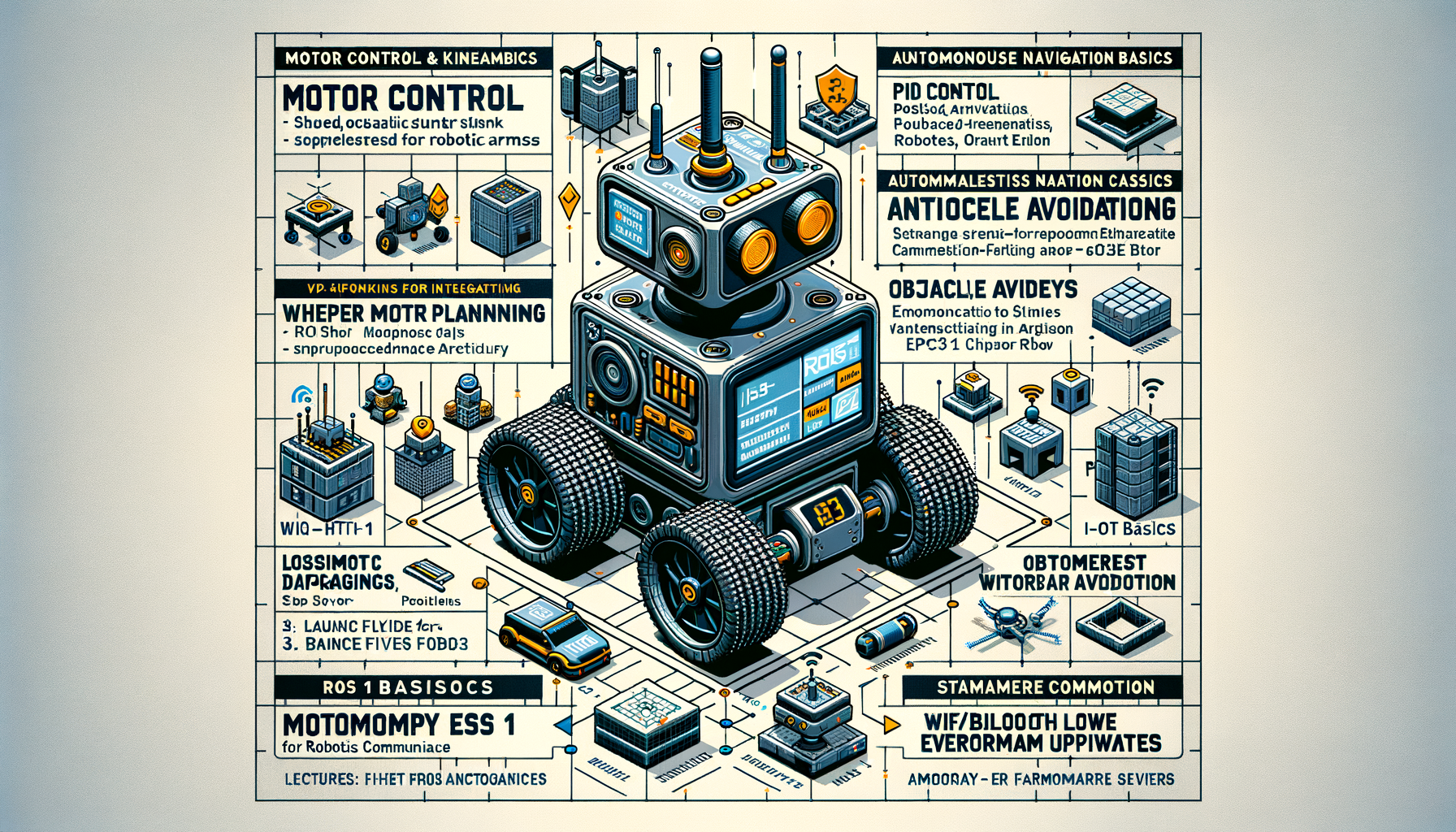
Robotics Control, Navigation, and IoT Fundamentals (Course 3 of 4)
This course provides a comprehensive introduction to motor control, navigation fundamentals, ROS integration, and IoT communication for robotics. In Week ...
Show more
Instructor
Jason James
- Description
- Curriculum
- FAQ
- Grade
Week 1: Motor Control & Kinematics
Written Lectures:
- PID control for precise motor positioning.
- Forward/inverse kinematics for robotic arms (2DOF/3DOF).
- Stepper motor control with TMC2209 drivers.
Labs (VS Code + PlatformIO):
- Tune PID parameters for a DC motor using PlatformIO’s Real-Time Plotting.
- Program a 3DOF arm to trace geometric shapes.
Audio Lectures:
- "Kinematics in CNC Machines" (20 mins).
- "PID Tuning in Autonomous Vehicles" (25 mins).
Assessments:
- Matching Quiz: Kinematics equations vs. robot types (10 questions).
- MCQ Quiz: 40 questions on PID control and motor drivers.
Week 2: Autonomous Navigation Basics
Written Lectures:
- Grid-based path planning (A* vs. Dijkstra algorithms).
- Obstacle avoidance using ultrasonic/LiDAR sensors.
- Odometry for wheeled robots.
Labs (VS Code + PlatformIO):
- Simulate a path-planning algorithm in Python for a mobile robot.
- Deploy the algorithm on an ESP32-controlled rover.
Audio Lectures:
- "Autonomous Robots in Warehousing" (30 mins).
- "Fail-Safe Mechanisms in Navigation" (20 mins).
Assessments:
- Matching Quiz: Navigation algorithms vs. scenarios (10 questions).
- MCQ Quiz: 40 questions on path planning and odometry.
Week 3: ROS 1 Basics for Integration
Written Lectures:
- ROS 1 architecture: nodes, topics, and messages.
- ROS kinetic vs. melodic: Version compatibility.
- Launch files and parameter servers.
Labs (VS Code + PlatformIO):
- Control a simulated TurtleBot2 using ROS 1.
- Publish/subscribe to sensor data topics.
Audio Lectures:
- "Legacy ROS in Manufacturing" (25 mins).
- "Migrating from ROS 1 to ROS 2" (20 mins).
Assessments:
- Matching Quiz: ROS 1 components vs. functions (10 questions).
- MCQ Quiz: 40 questions on nodes, topics, and launch files.
Week 4: IoT & Wireless Communication
Written Lectures:
- MQTT/HTTP for cloud-based robot control.
- Wi-Fi/Bluetooth Low Energy (BLE) for ESP32.
- OTA (Over-the-Air) firmware updates.
Labs (VS Code + PlatformIO):
- Program an ESP32 to send sensor data to a cloud dashboard.
- Implement OTA updates using PlatformIO’s OTA Plugin.
Audio Lectures:
- "IoT in Smart Factories" (30 mins).
- "Security Risks in Wireless Robotics" (20 mins).
Assessments:
- Matching Quiz: Wireless protocols vs. use cases (10 questions).
- MCQ Quiz: 40 questions on MQTT, BLE, and OTA.
Week 1: Motor Control & Kinematics
-
1
 PID control for precise motor positioning.In this lesson, "Mastering PID Control for Precision Motor Positioning," students will dive into the fundamentals of PID (Proportional, Integral, Derivative) control and its crucial role in achieving accurate motor positioning. Through hands-on examples and practical applications, learners will develop the skills to design, tune, and implement effective PID controllers, enabling them to enhance the performance of various motor-driven systems.
 -
2
Forward/inverse kinematics for robotic arms (2DOF/3DOF).In this engaging lesson, students will master the principles of forward and inverse kinematics for 2-degree and 3-degree-of-freedom (DOF) robotic arms, equipping them with the skills to calculate joint angles and end-effector positions. Through hands-on activities and real-world applications, learners will gain a deep understanding of how to manipulate robotic systems, paving the way for innovative solutions in robotics and automation.
-
3
Stepper motor control with TMC2209 drivers.In this engaging lesson on "Mastering Stepper Motor Control with TMC2209 Drivers," students will dive into the inner workings of stepper motors and discover how to effectively utilize TMC2209 drivers for precise control. Participants will learn to set up, configure, and program these drivers, gaining hands-on experience that empowers them to enhance their robotic and automation projects with smooth and accurate motor movements.
-
4
 Optimizing PID Control: Tuning DC Motor Parameters with PlatformIO Real-Time Plotting
 -
5
 Matching Quiz: Kinematics equations vs. robot types.
 -
6
MCQ Quiz: PID control and motor drivers.
Week 2: Autonomous Navigation Basics
-
7
Grid-based path planning (A* vs. Dijkstra algorithms).In this lesson, "Navigating the Grid: A Comparative Study of A* and Dijkstra Algorithms," students will explore the fundamental principles of grid-based path planning through a hands-on comparison of the A* and Dijkstra algorithms. By the end, learners will develop a deeper understanding of algorithm efficiency, heuristic functions, and real-world applications, empowering them to choose the right pathfinding technique for various scenarios. Join us for an engaging journey into the world of algorithms!
-
8
Obstacle avoidance using ultrasonic/LiDAR sensors.In this lesson, "Mastering Obstacle Avoidance: Utilizing Ultrasonic and LiDAR Sensors," students will explore the principles and applications of ultrasonic and LiDAR sensors in robotics. Through hands-on activities and real-world examples, learners will develop essential skills in programming these sensors to detect and navigate obstacles effectively, enhancing their understanding of autonomous systems and improving their problem-solving abilities in dynamic environments.
-
9
Odometry for wheeled robots.In this lesson, "Mastering Odometry: Navigating Wheeled Robots with Precision," students will delve into the fundamental principles of odometry and its critical role in enabling wheeled robots to accurately track their movements. Through hands-on activities and real-world applications, learners will gain the skills to calculate distances, estimate positions, and implement odometric algorithms, empowering them to enhance robotic navigation and performance. Join us to unlock the secrets of precise movement and elevate your robotic designs!
-
10
Path Planning in Python: Simulating Mobile Robot Navigation
-
11
Matching Quiz: Navigation algorithms vs. scenarios.
-
12
MCQ Quiz: Path planning and odometry.
Week 3: ROS 1 Basics for Integration
-
13
ROS 1 architecture: nodes, topics, and messages.In this lesson, "Understanding ROS 1 Architecture: Nodes, Topics, and Messages Unpacked," students will explore the fundamental components of the Robot Operating System (ROS 1) architecture. By the end of the session, participants will gain a clear understanding of how nodes interact, how topics facilitate communication between them, and how messages are structured to enable efficient data exchange, laying the groundwork for effective robotics programming. Join us to demystify these critical elements and empower your robotics journey!
-
14
ROS kinetic vs. melodic: Version compatibility.In this lesson, "Navigating ROS Kinetic and Melodic: Understanding Version Compatibility," students will explore the key differences between ROS Kinetic and Melodic, gaining insights into their compatibility and implications for robot development. By the end of the session, learners will confidently identify version-specific features and dependencies, enabling them to make informed decisions when choosing the right ROS version for their projects.
-
15
Launch files and parameter servers.In this lesson, "Mastering Launch Files and Parameter Servers in Robotics," students will explore the essential components of launch files and parameter servers, gaining hands-on experience in configuring and managing robotic systems. By the end of the session, participants will confidently create and execute launch files, as well as effectively utilize parameter servers to optimize their robot's performance, paving the way for successful robotic project implementation.
-
16
Mastering Robot Navigation: Controlling a Simulated TurtleBot2 with ROS 1
-
17
Matching Quiz: ROS 1 components vs. functions.
-
18
MCQ Quiz: Nodes, topics, and launch files.
Week 4: IoT & Wireless Communication
-
19
MQTT/HTTP for cloud-based robot control.In this dynamic lesson, "Mastering Cloud-Based Robot Control: MQTT vs. HTTP Explained," students will explore the fundamental differences and applications of MQTT and HTTP protocols in cloud-based robot control systems. By the end of the lesson, participants will gain a deep understanding of how to leverage these communication methods for efficient data transmission, enabling them to enhance their robotic projects and improve remote operation capabilities. Join us to unlock the potential of cloud connectivity in robotics!
-
20
Wi-Fi/Bluetooth Low Energy (BLE) for ESP32.In this dynamic lesson, "Mastering Wi-Fi and Bluetooth Low Energy (BLE) with ESP32," students will dive deep into the world of wireless communication, exploring how to seamlessly integrate Wi-Fi and BLE into their ESP32 projects. Participants will learn to set up connections, manage data transmission, and leverage the ESP32's capabilities to create innovative IoT applications, empowering them with the skills to transform their ideas into reality. Join us and unlock the potential of wireless technology!
-
21
OTA (Over-the-Air) firmware updates.In this lesson, "Mastering OTA Firmware Updates: Seamless Software Enhancements for Devices," students will explore the intricacies of Over-the-Air (OTA) firmware updates, learning how to effectively implement and manage these essential processes for enhancing device functionality. Participants will gain insights into best practices for ensuring secure and efficient updates, troubleshoot common issues, and understand the critical role of OTA in modern technology ecosystems.
-
22
Connecting the Future: Programming an ESP32 to Stream Sensor Data to the Cloud
-
23
Matching Quiz: Wireless protocols vs. use cases.
-
24
MCQ Quiz: MQTT, BLE, and OTA.
What is PID control and how is it used in motor positioning?
PID control is a feedback mechanism that adjusts motor input to minimize error between desired and actual positions. It's crucial for achieving precise motor positioning in robotic applications.
What is the difference between forward and inverse kinematics?
Forward kinematics calculates the end-effector position from joint angles, while inverse kinematics determines the necessary joint angles to achieve a desired end-effector position in robotic arms.
How can I tune PID parameters for a DC motor using PlatformIO?
You can tune PID parameters in PlatformIO by adjusting the proportional, integral, and derivative values in your code and observing the motor's response using Real-Time Plotting to achieve optimal performance.
What is the purpose of the TMC2209 driver in stepper motor control?
The TMC2209 driver is used for controlling stepper motors with features like silent operation and precise microstepping, making it ideal for applications requiring high torque and smooth motion.


Prerequisites
-
Introduction to Robot Operating Systems and Machine Learning (Course 2 of 4)
$200
-
What is Prerequisite coursesA prerequisite is a specific course that you must complete before you can take another course at the next grade level.
Course details
Duration
4 weeks
Lectures
12
Assignments
4
Quizzes
8
Level
Advanced Courses
Robotics Foundations Partial-Certification | 2.0 CEU
 Google
  Facebook